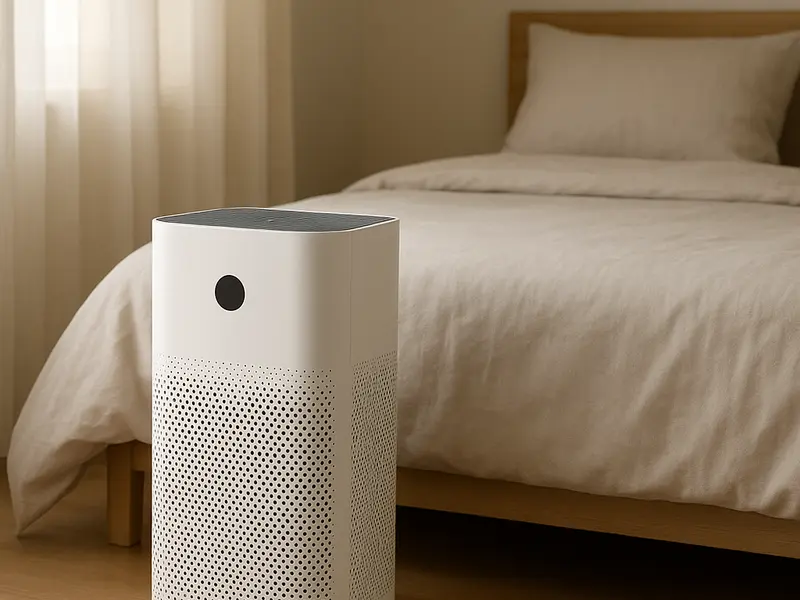
For most bedrooms, choose an air purifier whose smoke CADR is at least two-thirds of the floor area in square feet: about 80 for a 10 by 12 foot room, 100 for 150 square feet. Then size up one step, because you will run it on a quiet setting at night.
Related on Amazon · Paid links
-
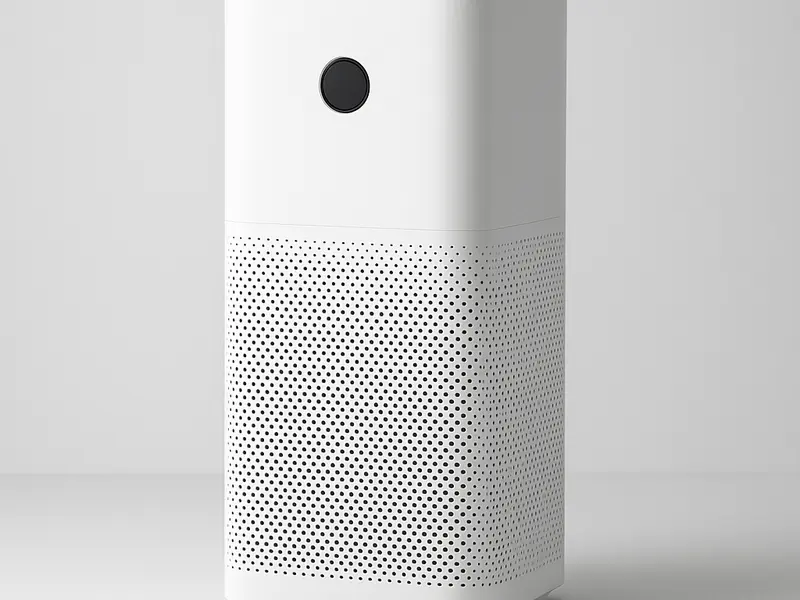 Top-Rated HEPA Air Purifiers on Amazon
Browse top-rated hepa air purifier on Amazon — compare prices, features, and customer reviews.
Check price on Amazon
We may earn a commission if you buy, at no extra cost to you.
The quick sizing rule and where it comes from
The number that matters is the Clean Air Delivery Rate (CADR), a standardized rating assigned through the Association of Home Appliance Manufacturers (AHAM) test. It is measured in cubic feet per minute and comes as three separate scores: smoke, dust and pollen. The EPA suggests looking at the smoke CADR when you care about small particles, because smoke represents the smallest of the three.
AHAM's rule of thumb is that the smoke CADR should be at least two-thirds of the room's area in square feet, assuming a standard 8-foot ceiling. Multiply length by width, then multiply by two-thirds:
- 100 sq ft bedroom (10 x 10): smoke CADR of at least 67
- 120 sq ft bedroom (10 x 12): at least 80
- 150 sq ft bedroom (10 x 15): at least 100
- 200 sq ft bedroom (14 x 14 or so): at least 133
- 250 sq ft primary bedroom: at least 167
Two adjustments change the math. If your ceiling is higher than 8 feet, AHAM notes you need a unit rated for a larger room; a simple way to adjust is to multiply the result by your ceiling height divided by 8. And for wildfire smoke, AHAM recommends a smoke CADR equal to the full room area, not two-thirds of it, so a 150 sq ft bedroom would want 150 or more.
Why a bedroom needs more headroom than the box suggests
CADR is measured with the purifier running on its highest fan speed. That is useful for comparing models, but very few people sleep next to a purifier on high. On a low or sleep setting, the unit moves far less air, so the clean air you actually get at night is well below the number on the box.
That is the main reason to buy a model rated for a bigger room than yours. A purifier with roughly twice the CADR your room needs can run at a quiet middle setting and still deliver what the rule calls for. A unit that just meets the minimum only does so at full blast, which is usually too loud for sleep.
Be cautious with "covers up to X square feet" claims on the packaging. Manufacturers do not all calculate room coverage the same way, so compare the CADR figures directly rather than the room-size headline.
A second check: air changes per hour
If you want to see how hard the purifier is working, convert CADR into air changes per hour (ACH), which tells you how many times per hour the unit can process the room's full volume of air:
- ACH = CADR x 60 / (floor area x ceiling height)
- Example: a CADR of 100 in a 150 sq ft room with an 8-foot ceiling gives 100 x 60 / 1,200 = 5 air changes per hour
The two-thirds rule works out to roughly five air changes per hour at top speed. Run the same math with the CADR you expect at your sleep setting (some manufacturers publish per-speed figures) to see what you actually get overnight.
Which size fits your situation
Small bedroom and a light sleeper
Choose a compact unit with a smoke CADR comfortably above your minimum and a genuine sleep mode. Look for published noise figures at the lowest speeds, a display that can be turned fully off, and controls that do not beep. A slightly oversized unit running slowly is quieter than a small one running hard.
Seasonal allergies, dust or pet dander
The pollen and dust CADR numbers matter more here, so check that they are as strong as the smoke number. Keep expectations realistic: heavier particles such as dust mite debris settle out of the air quickly, so a purifier only catches them while they are airborne. Washing bedding regularly and keeping pets off the bed still does a lot of the work. If your pet sleeps in the room, a washable or vacuumable pre-filter helps catch hair before it clogs the main filter.
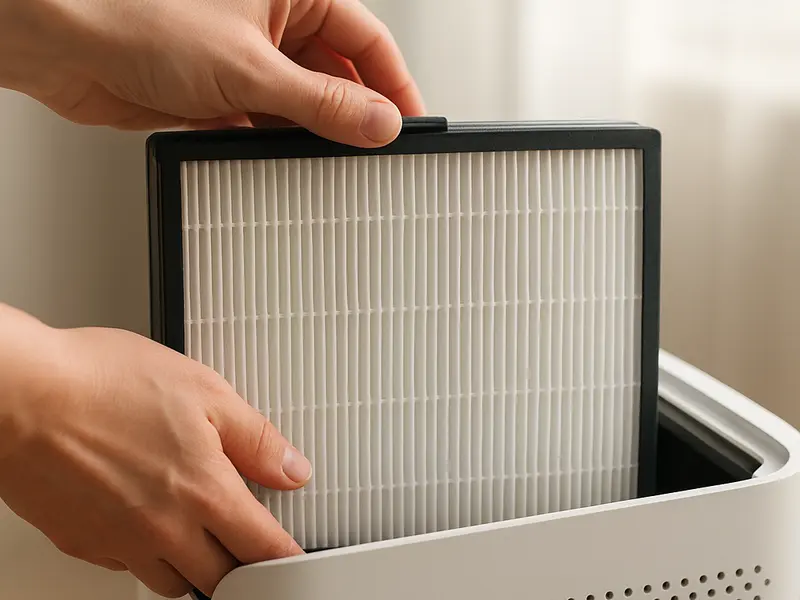
Wildfire smoke season
Size for a smoke CADR at least equal to the room's square footage, keep windows and the bedroom door closed, and run the unit continuously. This is the situation where buying more capacity than you think you need pays off most.
Odors, cooking smells or smoke you can smell
CADR only covers particles. Odors and gases need a sorbent filter such as activated carbon, and the amount of carbon matters. A thin sheet lightly coated with carbon does far less than a filter with a substantial bed of carbon pellets. If smells are the main complaint, check the carbon filter specification before the CADR.
Large primary bedroom or a room that opens onto another space
An open doorway, an ensuite without a door or a loft layout makes the effective room bigger. Either size for the combined area or consider two smaller units, one in each zone.
Features worth paying for
- True HEPA filtration. HEPA is defined by the U.S. Department of Energy as removing at least 99.97 percent of particles 0.3 microns in size. Terms like "HEPA-type" or "HEPA-like" do not promise that standard.
- A verified CADR. Look for the AHAM Verifide mark or a CADR listed in AHAM's directory instead of a manufacturer's own unverified number.
- A real sleep mode. It should lower the fan, dim or turn off lights and stay quiet. Some auto modes ramp the fan up loudly in the middle of the night, so check whether you can lock the speed.
- Affordable, easy-to-find replacement filters. Filters are the ongoing cost. Check the replacement price and how often the manufacturer says to change it before you buy the unit.
- An Energy Star label, understood correctly. It indicates energy efficiency only, which matters for a device that runs all night, but the EPA notes it says nothing about how well the unit cleans the air.
What to avoid
- Ozone generators. The EPA warns that ozone is a lung irritant, and that at concentrations within public health standards it does little to remove most indoor air pollutants. The California Air Resources Board strongly advises against using them at home.
- Unverified ionizers, plasma or UV add-ons. The EPA notes that ionizers, electrostatic precipitators, some UV lights and plasma air cleaners can emit ozone. If a model has one of these features, check that it is on the California Air Resources Board's list of certified air cleaners, and choose a model that lets you switch the feature off.
- Buying on CADR alone with no noise information. A high number does little good if you switch the unit off at bedtime because it is too loud.
Honest downsides
- Noise and airflow. Even good units make a steady hum at useful speeds, and some people find the breeze distracting. Others like it as white noise. If you are unsure, buy from a seller with an easy return policy.
- Running cost. Filters and electricity add up over a year of continuous use, and some brands charge a lot for proprietary filters.
- It does not fix the source. A purifier will not solve dampness, mold, a leaking appliance or poor ventilation. If the room smells musty, deal with humidity or the leak first. If new furniture or paint smells strongly, ventilation helps more than a particle filter.
- It is not medical treatment. A purifier can lower airborne particles, but if you have asthma or significant allergies, talk to your doctor about what else should be part of your plan.
Placement and running tips
- Put it in the bedroom itself. The EPA suggests placing air cleaners in the rooms where you spend the most time, and for most people that is where they sleep.
- Keep the bedroom door closed while it runs, so the unit is not trying to clean the whole house.
- Leave the clearance from walls and furniture that the manual specifies, and never block the intake or outlet.
- Run it continuously. The EPA notes that higher fan speeds and longer run times both increase the amount of air filtered. A common approach is to run it on high while you are out of the room, then drop to sleep mode at bedtime.
- Replace or clean filters on schedule. A clogged filter moves less air and works less well.
A practical decision checklist
- Measure the room's floor area and multiply by two-thirds to get your minimum smoke CADR. Use the full area if wildfire smoke is a concern.
- Adjust upward if your ceiling is taller than 8 feet or the room opens onto another space.
- Size up so a quiet setting still delivers close to your minimum. Roughly double the minimum is a comfortable target for light sleepers.
- Confirm true HEPA and a verified CADR rather than marketing terms.
- Add a substantial carbon filter if odors or smoke smells are part of the problem.
- Rule out ozone generators, and check any ionizer or UV feature against the CARB certified list.
- Check noise figures and sleep-mode behavior, including lights and beeps.
- Price out replacement filters and how often they need changing before you commit.