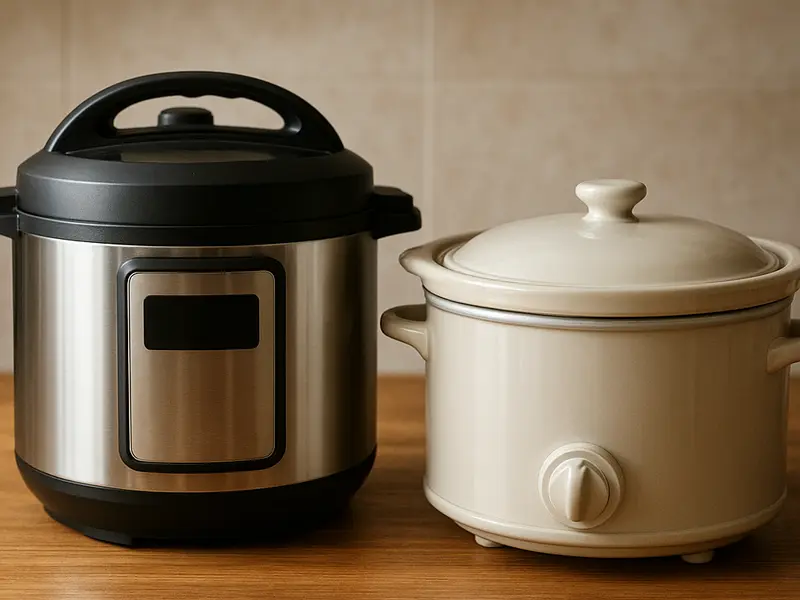
Buy an Instant Pot or similar multi-cooker if you want fast weeknight meals and one appliance that does several jobs. Buy a traditional slow cooker if you want simple, set-and-forget cooking while you are out, and rarely need dinner in under an hour.
Products in this article · Paid links
- Multi-Cookers on Amazon (Instant Pot and others) Browse top-rated instant pot on Amazon — compare prices, features, and customer reviews. Check price on Amazon
- Slow Cookers on Amazon Browse top-rated slow cooker on Amazon — compare prices, features, and customer reviews. Check price on Amazon
We may earn a commission if you buy, at no extra cost to you.
The short answer
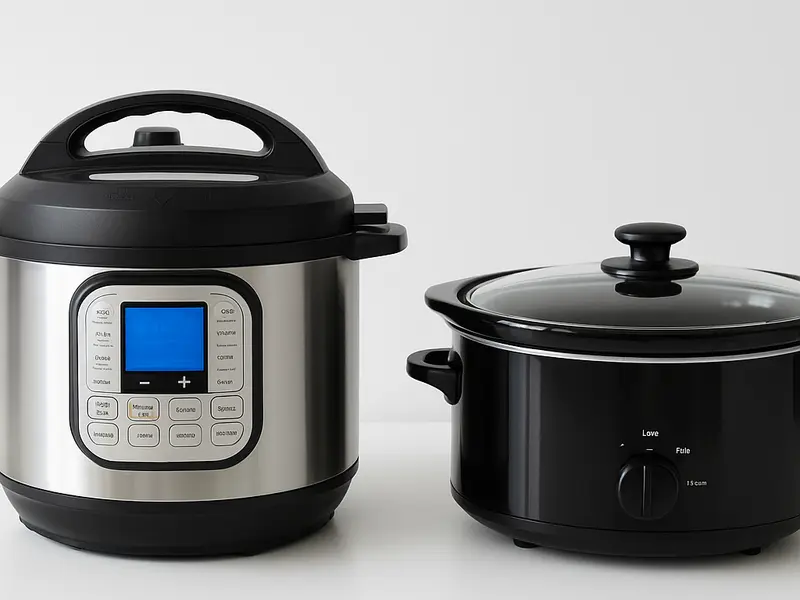
- A multi-cooker wins on speed and versatility. Instant Pot is a brand of electric multi-cooker; most models combine a pressure cooker with slow-cook, sauté, steam and rice functions, and many add yogurt or other modes. Pressure cooking makes stews, beans, grains and tough cuts of meat in a fraction of the usual time.
- A slow cooker wins on simplicity. There is no pressure, no sealing ring and no valve to manage. You add food, set it to low or high, and leave.
- The slow-cook mode on a multi-cooker is not identical to a slow cooker. It works, but results can differ, so recipes written for a stoneware slow cooker may need adjusting.
- If you mostly cook long, gentle braises while at work, a slow cooker is the easier and often cheaper tool. If you often decide what to cook at 6 p.m., a multi-cooker is the more useful one.
How each one actually cooks
Slow cooker
A slow cooker heats a ceramic stoneware insert gently for hours. Many models heat the insert from the sides as well as the base, and the heavy stoneware holds heat well. Food cooks below the boiling point for most of the time, which is why tough cuts become tender and why there is little risk of scorching when the pot is filled properly.
Electric pressure cooker (multi-cooker)
A pressure cooker seals the pot so steam builds pressure inside. That raises the boiling point of water well above 212°F, so food cooks much faster. Multi-cookers usually use a metal inner pot heated from an element underneath, and the same pot is used for sautéing, pressure cooking and slow cooking.
The time on a pressure cooking recipe is usually the time under pressure, not the total. The pot also needs time to come up to pressure, often several minutes to ten minutes or more depending on how full it is, and then time to release pressure. A natural release can take ten to fifteen minutes or longer. A recipe listed as "20 minutes" can easily take 40 or more from start to finish. That is still much faster than an eight-hour slow cook, but it is not instant.
Where a multi-cooker is clearly better
- Speed for tough cuts. Beef chuck, pork shoulder and similar cuts become tender far faster under pressure.
- Dried beans. A pressure cooker cooks soaked dried beans quickly, and it gets well above boiling. A slow cooker may not; the FDA warns that slow cookers may not get hot enough to destroy the natural toxin in dried red kidney beans, so those need boiling first if you use a slow cooker.
- Browning in the same pot. The sauté function lets you brown meat and onions before cooking without dirtying a pan. Some slow cookers have a sear function or a stovetop-safe insert, but most use stoneware that cannot go on a burner.
- Grains and stocks. Rice, risotto-style dishes and stock are quick and hands-off.
- One appliance instead of several. If counter and cupboard space are tight, one multi-cooker can replace a rice cooker, a steamer and a slow cooker.
Where a slow cooker is clearly better
- Long, unattended cooking. Set it in the morning and come home to dinner, without any pressure release to manage.
- Simplicity. Fewer settings, no sealing ring to clean or replace, and no steam release to keep away from cabinets.
- Dishes with dairy or thick sauces. Thick, starchy or dairy-heavy mixtures can scorch on the bottom of a pressure cooker and may trigger a burn warning. In a slow cooker, they simply cook gently. With either appliance, recipes often add dairy near the end.
- Larger, shallower cooking for roasts. Oval slow cookers handle long cuts and whole birds easily; most multi-cooker pots are tall and round.
- Serving. A slow cooker on keep-warm is a natural buffet server for chili, dips and meatballs.
The trade-offs nobody puts on the box
Multi-cooker downsides
- A learning curve. Natural versus quick release, sealing the valve, minimum liquid amounts and fill limits all matter. Electric pressure cooker manuals typically limit filling to two-thirds of the pot, and to half for foods that foam or expand such as rice, beans and grains. Always follow your model's manual.
- The sealing ring. The silicone ring can absorb food odors, and it wears out. Manufacturers sell replacements; replace it when it cracks, deforms or no longer seals.
- Steam release. A quick release sends a strong jet of hot steam out of the valve. Keep the cooker out from under cabinets and keep hands and faces clear.
- You cannot check or adjust mid-cook under pressure. If the meat is not tender enough, you release pressure, check, and bring it back up, which adds time.
Slow cooker downsides
- No speed option. If you forget to start it in the morning, it cannot help you at dinnertime.
- Usually no browning. Many recipes taste better with meat browned first, which means an extra pan unless your model has a sear function.
- Heavy, fragile insert. Stoneware can crack if dropped or exposed to sudden temperature changes, so follow the manual's care instructions.
- Food safety needs a little care. USDA guidance is to thaw meat before slow cooking, fill the cooker half to two-thirds full and keep the lid on. These rules are easy, but they matter.
What about the slow-cook mode on a multi-cooker?
It is useful, but treat it as a bonus rather than a reason to skip a slow cooker if slow cooking is your main habit. The heating design differs from most stoneware cookers, and owners commonly report that the same recipe can cook faster or slower than expected. If you plan to use it often, read your model's slow-cook guidance, consider a glass lid designed for that model, and check food earlier the first few times.
One more caution: do not use a multi-cooker for pressure canning unless its manufacturer specifically says it is designed and tested for that purpose. The National Center for Home Food Preservation has advised against using electric multi-cookers for pressure canning, because tested, safe canning processes have not been established for them.
Which should you buy?
Choose a multi-cooker if
- You often cook dinner without much planning.
- You cook dried beans, grains, stocks or tough cuts often.
- You have limited storage and want one appliance to cover several jobs.
- You are comfortable reading a manual and learning a few new steps.
Choose a slow cooker if
- You want dinner ready when you get home after a long day.
- You want the simplest possible appliance with very little to learn.
- You cook a lot of chili, soup, pulled meat and braises, or you entertain and want a buffet server.
- Someone in the household is uneasy about pressure cooking.
Consider owning both if
- You batch cook for a large household or for the freezer.
- You often serve one dish warm while cooking another.
Size: match it to your household
Multi-cookers and slow cookers are both sold by quart capacity, and a 6-quart model is a common choice for a family of three to five. A 3-quart multi-cooker suits one or two people, and 8 quarts suits large families or batch cooking. Remember that usable capacity is smaller than the label in both cases: about two-thirds for pressure cooking (half for expanding foods), and half to two-thirds for a slow cooker.
A practical decision checklist
- Decide what problem you are solving: speed on short notice (multi-cooker) or cooking while you are away (slow cooker).
- List the dishes you cook most. Beans, grains, stock and fast braises point to a multi-cooker; long braises, chili for a crowd and buffet serving point to a slow cooker.
- Check the multi-cooker's fill limits and minimum liquid in the manual before you buy, and make sure you are comfortable with steam release.
- If you choose a multi-cooker, buy a spare sealing ring and plan to replace it when it wears.
- If you choose a slow cooker, pick a programmable model that switches to warm automatically.
- Size for your household: about 3 quarts for one or two people, 6 quarts for most families, 8 quarts for big batches.
- Boil dried red kidney beans before slow cooking, or pressure cook them, or use canned beans.
- Do not pressure can in a multi-cooker unless the manufacturer specifically approves it.