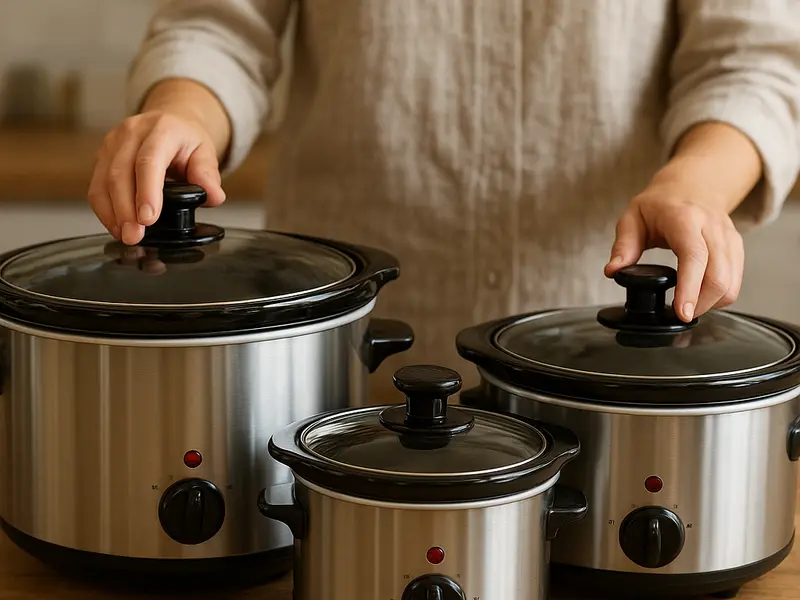
Most households of three to five people are best served by a 6-quart slow cooker. Pick 1.5 to 3 quarts for one or two people or for dips, and 7 to 8 quarts for big roasts and batch cooking. Any size works best filled half to two-thirds full.
Related on Amazon · Paid links
- Slow Cookers on Amazon Browse top-rated slow cooker on Amazon — compare prices, features, and customer reviews. Check price on Amazon
We may earn a commission if you buy, at no extra cost to you.
The short answer
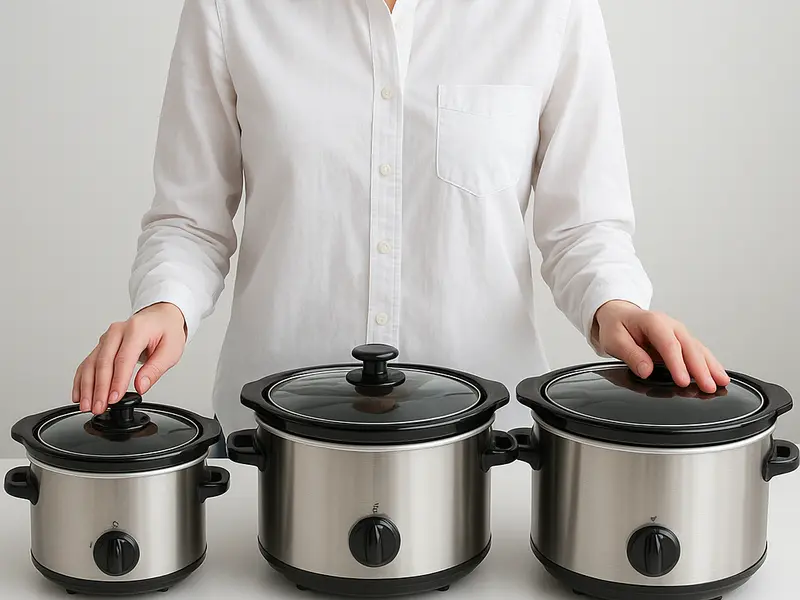
- 1.5 to 3 quarts: one or two people, dips, sauces, side dishes and small batches. Also a good second cooker for parties.
- 4 to 5 quarts: two to four people who want leftovers for a lunch or two, or a small household that cooks soups and stews often.
- 6 quarts: a very common family size and the most versatile. Typically fits a family-size stew, chili or pot roast with room to spare.
- 7 to 8 quarts: large families, entertaining, freezing meals in bulk, or large cuts of meat.
- If you are unsure between two sizes, think about how often you will cook the full amount. A cooker that is regularly less than half full is too big for you.
Why the fill level matters more than the number on the box
The capacity on the box is the total volume of the insert, up to the rim. You never cook at that volume. The USDA advises filling a slow cooker no less than half and no more than two-thirds full, and most slow cooker manuals give a similar range.
That gives you a simple way to translate the label into real food:
- A 3-quart cooker comfortably holds about 1.5 to 2 quarts of food.
- A 6-quart cooker comfortably holds about 3 to 4 quarts of food.
- An 8-quart cooker comfortably holds about 4 to 5 quarts of food.
Both ends of the range matter. In a cooker that is too empty, food heats faster than the recipe expects and can dry out, scorch at the edges or overcook. In a cooker that is too full, food takes longer to heat through, and it may bubble over. Food safety guidance stresses that food should move through the temperature "danger zone" of 40 to 140°F quickly, which is one reason overfilling is a problem and not just a mess.
How to size by household and cooking style
One or two people
A 2- to 3-quart model handles most recipes scaled for two, with a little left over. The catch is that many published slow cooker recipes are written for 5- to 6-quart cookers. If you like to follow recipes as written, or cook once and eat twice, a 4-quart model is a reasonable compromise. Halving a large recipe in a large cooker is the setup most likely to leave you with a half-empty pot and overcooked food.
Three or four people
A 5- or 6-quart cooker is the usual pick. It fits standard recipes, gives you leftovers and still sits within the half-to-two-thirds window for everyday meals. If you mainly make soups and chili, 5 quarts is often enough. If you want to cook roasts, a whole chicken or larger batches, go to 6.
Five or more people, or batch cooking
Look at 7 or 8 quarts. This size makes sense if you regularly cook for a crowd or freeze portions. Remember the fill rule works in both directions: an 8-quart cooker needs a lot of food to be at least half full, so it is a poor fit for small weeknight meals.
Entertaining
Small 1.5- to 2-quart units are useful for keeping dips, sauces or mulled drinks warm on a buffet. Some households keep a small cooker alongside a 6-quart model rather than buying one oversized unit to do everything.
Oval or round?
Shape matters almost as much as volume.
- Oval inserts fit long cuts such as roasts, ribs and whole birds more easily. They also take up more counter width.
- Round inserts suit soups, stews, chili, beans and grains, and often take up a slightly smaller footprint.
- If you are buying one cooker for everything, an oval 6-quart is the most flexible shape because it handles both large cuts and liquid dishes.
Before buying for a specific job, such as a whole chicken, check the insert's inside dimensions in the product listing or manual rather than relying on the quart number alone. Two cookers with the same capacity can have quite different shapes.
Features that matter more as size goes up
A programmable timer with automatic keep-warm
For anyone who is out all day, this matters more than size. A programmable model cooks for the time you set and then switches to a warm setting, which helps if you are out all day. A keep-warm setting holds cooked food; it is not meant for cooking or reheating.
Weight and handling
A large stoneware insert full of food is heavy and hot. If lifting is a concern, check the weight of the insert, look for sturdy side handles, and consider a size smaller than you think you need.
Insert material
Most slow cookers use a ceramic stoneware insert that holds heat well. Some models have a metal insert that can go on the stovetop or use a built-in sear function, so you can brown meat in the same pot. Only use an insert on a burner or in an oven if the manufacturer's manual says it is safe to do so.
Lid design
Glass lids let you check on food without lifting the lid. Locking lids with clips and a gasket are worth it if you carry food to gatherings.
Storage and cleaning
Measure the cabinet or shelf where it will live, and check whether the insert fits in your sink or dishwasher. A 7- or 8-quart insert can be awkward in a small kitchen.
Common sizing mistakes
- Buying the biggest model "just in case." If most of your meals only fill it a third of the way, food will cook unevenly and dry out.
- Doubling a recipe in the same cooker. If the doubled amount goes past two-thirds full, it may not heat through in the time given.
- Ignoring the recipe's stated size. Cooking times are written for a particular fill level. Check what size the recipe assumes and adjust, checking for doneness earlier in a fuller-than-expected or emptier-than-expected pot.
- Choosing by capacity alone. A whole chicken or a long roast may fit an oval cooker but not a round one of the same size.
Safety points that apply to any size
- Thaw first. USDA guidance is to thaw meat and poultry before putting them in a slow cooker, so the food does not spend too long at unsafe temperatures. Cutting large pieces into smaller chunks also helps them heat through.
- Keep the lid on. Each time you lift it, heat escapes and cooking takes longer.
- Be careful with dried red kidney beans. Raw and undercooked kidney beans contain a natural toxin, phytohaemagglutinin. The FDA advises soaking and boiling dried kidney beans, and warns that slow cookers may not get hot enough to destroy the toxin. Boil soaked beans before they go in, or use canned beans.
- Do not reheat leftovers in a slow cooker. USDA guidance is to reheat cooked food on the stove, in the microwave or in the oven to 165°F; it can then go into a preheated slow cooker to stay warm for serving.
- Refrigerate leftovers promptly. Move them into shallow containers rather than storing them in the insert, which stays warm for a long time.
When a slow cooker is not the right buy
If you want dinner fast on short notice, a slow cooker will frustrate you; most recipes need several hours. An electric multi-cooker with a pressure function covers quick meals and also has a slow-cook mode, though results can differ from a traditional slow cooker. If you rarely cook stews, braises, soups or beans, a good Dutch oven may cover the same dishes without adding another appliance.
A practical decision checklist
- Count how many people you usually feed and whether you want leftovers.
- Pick the size whose half-to-two-thirds range matches your usual meal: about 2 to 3 quarts for one or two people, 5 to 6 quarts for three to four, and 7 to 8 quarts for larger families or batch cooking.
- Choose an oval shape if you want to cook roasts, ribs or whole poultry; round is fine for soups and stews.
- Prefer a programmable model that switches to warm automatically if you are out all day.
- Check the insert's weight, handles and whether it fits your sink, dishwasher and cupboard.
- Only use a metal or stovetop-safe insert on a burner if the manual says so.
- Thaw meat first, keep the lid on, boil dried kidney beans before slow cooking, and reheat leftovers on the stove or in the microwave.