
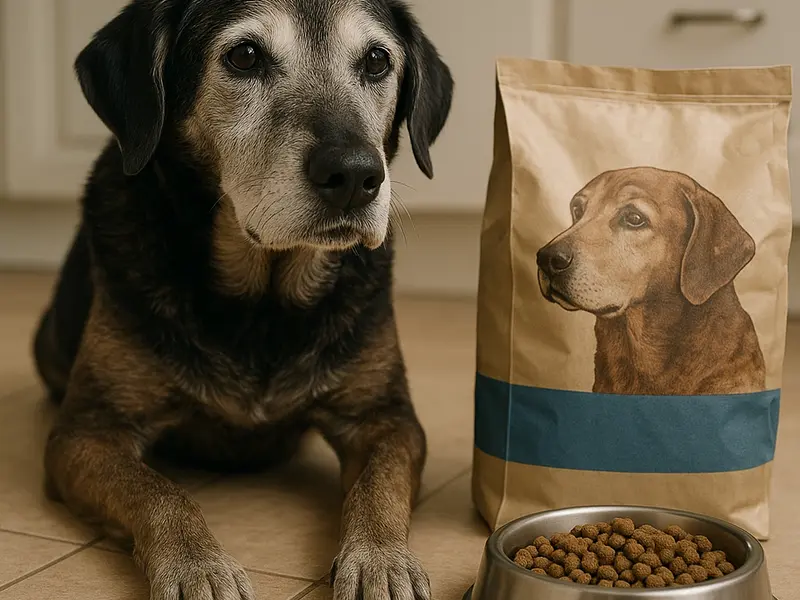
There is no single age at which every dog should switch to senior dog food. The better question is whether your dog's current food still fits their body condition, activity level and health. Many dogs can stay on a good adult food well into their senior years, while others benefit from a change. The best time to decide is at a senior wellness visit with your veterinarian, who can look at your dog's weight, muscle, teeth and bloodwork.
Products in this article · Paid links
-
 Top-Rated Dog Food on Amazon
Browse top-rated dog food on Amazon — compare prices, features, and customer reviews.
Check price on Amazon
- Purina Pro Plan Shredded Blend Chicken & Rice Vet-nutritionist-formulated adult dry food, chicken first. Check price on Amazon
- Hill's Science Diet Adult Savory Stew (Wet) Complete-and-balanced wet food for picky eaters. Check price on Amazon
We may earn a commission if you buy, at no extra cost to you.
When is a dog considered a senior?
The American Animal Hospital Association (AAHA) defines a senior dog as one in the last 25% of their estimated lifespan, rather than using a fixed age. Because larger dogs tend to have shorter lifespans, they usually reach their senior years earlier than small dogs. As a rough guide, a giant breed may be considered senior at around six or seven, while a small breed may not be until around ten or later. Your veterinarian can help you estimate where your dog falls.
What "senior" on the label actually means
This is the most important thing to know before shopping: there is no official nutrient standard for senior dog food. The Association of American Feed Control Officials (AAFCO) has nutrient profiles for growth and reproduction and for adult maintenance, but not for seniors. A food labeled "senior," "mature" or "aging" only has to meet the adult maintenance profile.
As a result, senior foods vary widely. A Tufts University study of about 37 over-the-counter senior dog foods found large differences in calories, protein, fat, sodium and phosphorus between products. Calories alone ranged from about 246 to 408 per cup. Two "senior" foods can be completely different diets, so you need to look at what is actually in the bag.
How senior foods are often designed
Many, though not all, senior formulas make some of these changes:
- Lower calories, for less active dogs prone to weight gain. Some senior foods are actually higher in calories, which can suit older dogs that are losing weight.
- Adjusted protein. Healthy older dogs do not need protein restriction; many need enough high-quality protein to maintain muscle as they age. Dogs with kidney disease are a different case and need a diet chosen with your veterinarian.
- More fiber in some products, which can help with satiety and stool quality.
- Added omega-3 fatty acids, glucosamine or chondroitin for joint support. A Tufts veterinary nutrition article notes that the amounts in most over-the-counter foods are much lower than the doses used in studies, so these foods are not a substitute for a joint supplement or therapeutic diet your vet recommends.
- Different textures, such as smaller kibble or wet versions, which can help dogs with dental problems.
Signs it may be time to review your dog's food
- Weight gain as your dog becomes less active.
- Weight or muscle loss, especially along the spine and back legs.
- Reduced appetite or trouble chewing, which may point to dental disease.
- Changes in stool quality, such as constipation or loose stools.
- Stiffness, slowing down or reluctance to exercise.
- Drinking or urinating more, which can signal kidney disease, diabetes or other conditions.
Several of these signs can be caused by health problems rather than normal aging. Weight loss, increased thirst or a change in appetite should prompt a veterinary visit before you change foods.
Matching the food to your dog
- Large or giant breed with stiff joints: keeping your dog lean is one of the most helpful things you can do for arthritis. Look for a food that helps maintain a healthy weight, and ask your veterinarian about joint supplements, a therapeutic joint diet and pain management.
- Small dog with dental problems: have the teeth checked first, since dental disease is common in small dogs and can be painful. Softer food or smaller kibble can help while you address the underlying issue.
- Dog with kidney, heart or other chronic disease: do not choose a senior food on your own. These conditions often call for therapeutic diets with specific nutrient levels, prescribed by your veterinarian.
- Overweight dog: a lower-calorie food can help, but measured portions and fewer treats matter more. Your vet can calculate a target calorie intake.
- Underweight or thin older dog: a lower-calorie senior food may be the wrong choice. Your dog may need a more calorie-dense or more palatable food, and unexplained weight loss needs a vet visit.
- Healthy, active senior: if your dog is at a good weight and doing well on their adult food, there may be no reason to switch yet.
What to look for on the label
- An AAFCO nutritional adequacy statement showing the food is complete and balanced for adult maintenance (or all life stages).
- Calories per cup or can, so you can compare foods and adjust portions.
- The guaranteed analysis for protein, fat, fiber and moisture. Keep in mind it lists minimums and maximums rather than exact amounts.
- Feeding guidelines as a starting point, adjusted to your dog's body condition.
- Manufacturer information. The World Small Animal Veterinary Association (WSAVA) suggests asking whether a company employs a qualified nutritionist and how its diets are formulated and tested.
Ingredient lists and marketing terms tell you less than many people think. A named meat first on the list does not, on its own, tell you whether the food is right for your dog.

How to transition safely
- Mix a small amount of the new food into the old food.
- Gradually increase the new food over about a week, or longer if your dog has a sensitive stomach.
- Watch appetite, stool quality and energy.
- If vomiting or diarrhea develops, slow down, and call your vet if it persists or your dog seems unwell.
- Weigh your dog a few weeks after the change and adjust portions as needed, since calorie density often differs between foods.
Pros and cons at a glance
Pros
- A lower-calorie senior food can help a less active dog stay lean.
- Softer textures and smaller kibble can help dogs with dental issues.
- Some formulas include added fiber or omega-3s that may suit individual dogs.
Cons
- "Senior" has no regulated meaning, so products vary widely.
- Some senior foods are lower in protein or calories than a particular dog needs.
- Joint-support ingredients are often present in small amounts.
- A general senior food is not a substitute for a therapeutic diet when one is needed.
When not to switch yet
- Your dog is healthy, at a good weight and doing well on their current food.
- Your dog has a new or worsening medical condition that needs a vet-recommended diet.
- You are switching only because of a birthday, without looking at weight, health and activity.
Common mistakes
- Assuming all senior foods are alike.
- Switching foods to address weight loss, thirst or appetite changes without a vet check.
- Restricting protein in a healthy older dog based on outdated kidney concerns.
- Keeping portion sizes the same after switching to a food with different calories.
- Changing food too quickly.
Decision checklist you can act on today
- Has your dog had a recent senior wellness exam, including bloodwork if your vet recommends it?
- Is your dog gaining weight, losing weight or losing muscle?
- Does your dog have dental issues, stiffness or changes in thirst or urination?
- Has your veterinarian recommended a specific diet for a medical condition?
- Have you compared calories per cup and the nutritional adequacy statement of the foods you are considering?
- Can you transition gradually over about a week and recheck weight afterward?
Bottom line
Switch to a senior dog food when it better fits your individual dog, not because of a birthday. Since "senior" has no official nutrient standard, compare the actual calories and nutrients, keep your dog lean, and make sure they keep enough protein to maintain muscle. Above all, involve your veterinarian, especially if your dog is losing weight, drinking more, or has a chronic health condition, because those dogs may need a specific diet rather than a generic senior formula.