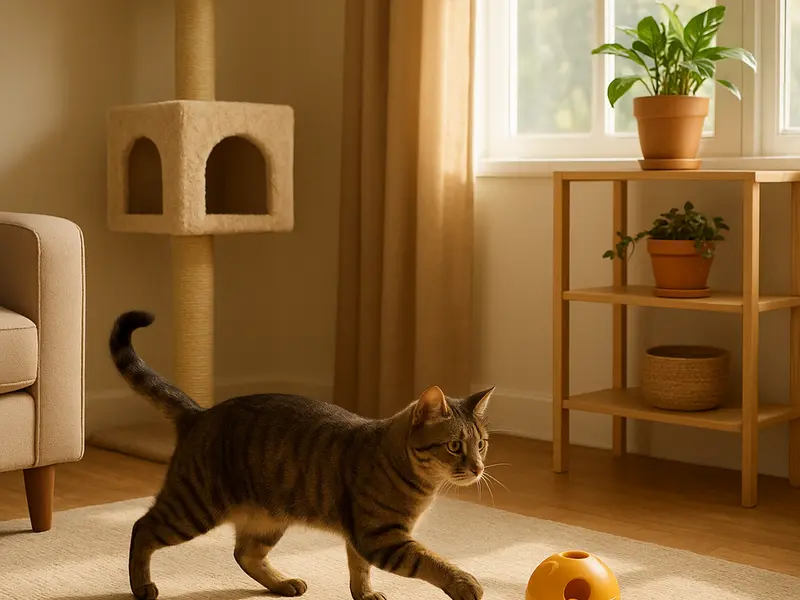
Indoor cats can live long, healthy lives, but an indoor home needs to give them outlets for the things cats are built to do: hunt, climb, scratch, explore, hide and rest somewhere safe. The enrichment ideas that work best are not expensive gadgets. They are daily play that mimics hunting, food that has to be found or worked for, safe high places, a view outside, and a few scents and textures to investigate.
Related on Amazon · Paid links
-
 Interactive Cat Toys on Amazon
Browse top-rated interactive cat toys on Amazon — compare prices, features, and customer reviews.
Check price on Amazon
-
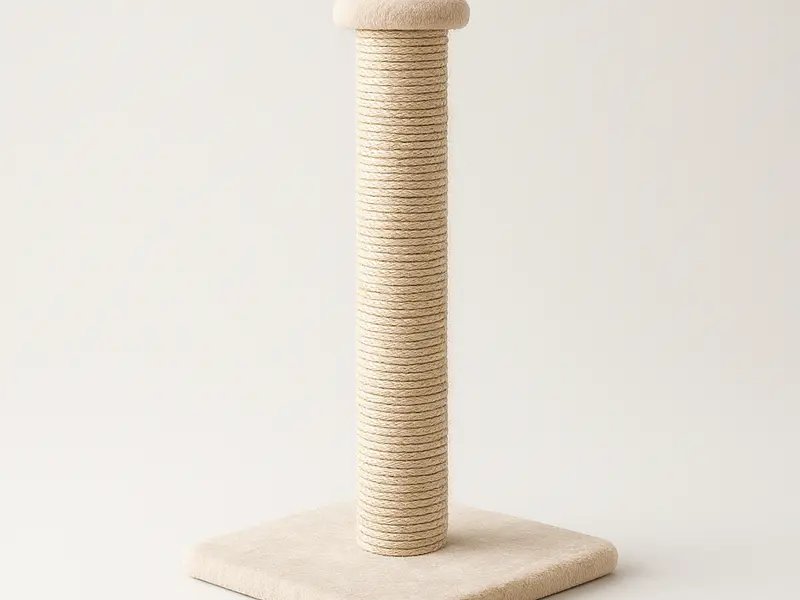 Tall Cat Scratching Posts on Amazon
Browse top-rated tall sisal cat scratching post on Amazon — compare prices, features, and customer reviews.
Check price on Amazon
-
 Best Cat Litter on Amazon
Browse top-rated cat litter on Amazon — compare prices, features, and customer reviews.
Check price on Amazon
We may earn a commission if you buy, at no extra cost to you.
What indoor cats actually need
Feline veterinary guidelines from the American Association of Feline Practitioners (AAFP) and International Society of Feline Medicine (ISFM) describe five "pillars" of a healthy environment for cats:
- A safe place: somewhere private, often raised or enclosed, where your cat can retreat.
- Multiple, separated key resources: food, water, litter boxes, scratching areas, play areas and resting spots in more than one place, especially in multi-cat homes.
- Opportunities for play and predatory behavior: the guidelines note that predatory behavior occurs even in well-fed cats.
- Positive, predictable human interaction on the cat's terms.
- Respect for the cat's sense of smell: cats rely heavily on scent to feel secure.
The ideas below are built around those needs.
Start with a space and cat assessment
Before buying anything, look at your home and your cat.
- Note the spaces your cat already uses: windowsills, the back of the sofa, the top of the fridge. These are clues to where your cat wants to be.
- Observe your cat's personality. A food-motivated cat may love puzzle feeders, a high-energy cat may need more active play, and a shy cat may need more hiding places first.
- Check accessibility for kittens, senior cats and cats with arthritis. Ramps, steps and lower perches help older cats keep using favorite spots.
Play that mimics hunting
Interactive play is one of the most effective forms of enrichment because it lets your cat stalk, chase, pounce and catch.
Wand and teaser toys
- Move the toy like prey: let it hide, dart away, pause and twitch, rather than dangling it in your cat's face.
- Let your cat "catch" the toy regularly, and end each session with a final catch. Offering a treat or meal afterward completes the hunt-catch-eat sequence that many behaviorists recommend.
- Short sessions work well. Several brief play sessions a day often suit cats better than one long one.
Safety note: string, yarn, ribbon and the cords on wand toys are a serious hazard if swallowed. Linear objects like these can cause severe intestinal injury that needs emergency surgery. Supervise all play with wand toys, and put them away out of reach when you are done. Never leave a tethered or string toy out for unsupervised play.
Solo toys
- Small balls, crinkle toys, fabric mice and kicker toys give your cat something to bat around when you are not playing together.
- Avoid toys with small parts that can be chewed off and swallowed, and throw away damaged toys.
- Motorized and battery-operated toys can add variety. Supervise them at first, make sure your cat cannot get to batteries or small parts, and keep them as an extra rather than a replacement for play with you.
- Laser pointers can trigger chasing, but since your cat can never catch the dot, finish with a physical toy your cat can grab.
Food-linked enrichment
In the wild, cats eat many small meals and work for each one. The AAFP's consensus statement on feline feeding programs encourages food puzzles, foraging-style feeding and multiple feeding stations to meet this need.
- Food puzzles range from simple balls that drop kibble when rolled to more complex designs. Start with the easiest version so your cat succeeds quickly, then increase the challenge.
- Hide small portions of your cat's daily food around the home for them to find.
- Lick mats and shallow slow-feed plates work for wet food and can slow down fast eaters.
- Measure from the daily ration. Food used in puzzles and games should come out of your cat's daily food allowance, not be added on top, to prevent weight gain.
- Clean puzzles regularly, especially after wet food.
- Do not let your cat go hungry while learning a new puzzle. If your cat is not eating enough from it, go back to an easier version and offer a normal bowl. Cats that stop eating can become seriously ill, so call your vet if your cat stops eating.
Vertical space and safe exploration
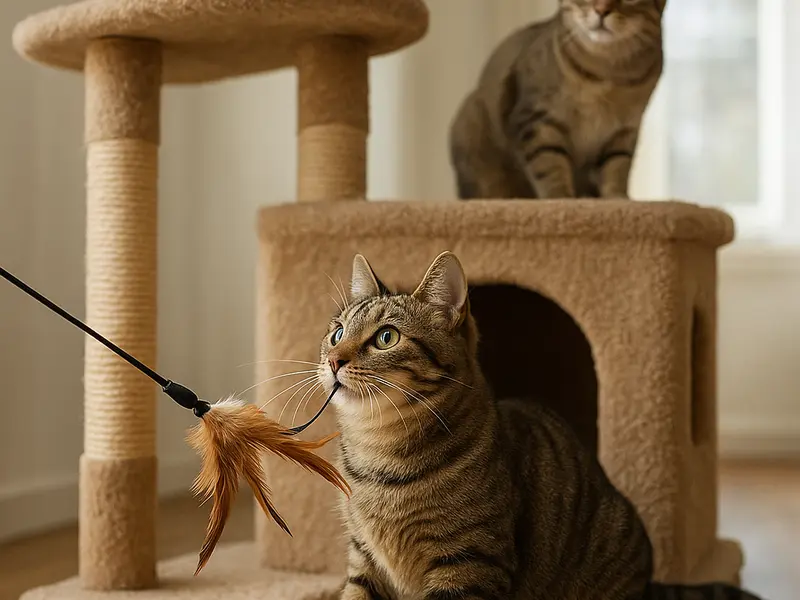
Cats like to climb and to observe from above, and high places can help cats feel secure.
- Choose sturdy cat trees or wall shelves designed for cats. Anchor shelves into studs or with suitable heavy-duty fixings, and anchor tall trees so they cannot tip.
- Provide a mix of levels, perches and enclosed hideaways so your cat can choose between watching, resting and hiding.
- In multi-cat homes, offer several routes and escape options so one cat cannot block another.
- For shy or older cats, start with low perches and ramps and add height gradually.
Window views
- A window perch or a cat tree by a window gives your cat something to watch throughout the day.
- A bird feeder outside a window can add interest, but watch for frustration. Some cats become agitated when they can see birds or other cats but cannot reach them.
- Make sure screens are secure. Cats can fall from open windows and balconies.
- A safe outdoor enclosure ("catio") or harness training are options for supervised outdoor time, introduced gradually.
Scent enrichment
- Catnip and silver vine: in a 2017 study of 100 cats published in BMC Veterinary Research, about 68% responded to catnip and about 79% to silver vine. If your cat ignores catnip, silver vine may still work. Young kittens often do not respond yet.
- New smells: a cardboard box, a paper bag (with handles removed), or an item brought in from outside can be interesting to investigate.
- Cat grass: many cats enjoy chewing safe cat grass. Keep toxic plants out of the home; lilies are especially dangerous to cats, and even small exposures can cause kidney failure.
- Avoid essential oils and diffusers. The ASPCA Animal Poison Control Center warns that cats are especially sensitive to many essential oils, which can cause drooling, vomiting and breathing problems.
Routine, variety and maintenance
- Rotate toys. Keep a few toys out and swap them every few days or once a week, so old toys feel new again.
- Play every day. Short, regular play sessions at predictable times, such as before meals, work well for most cats.
- Keep things clean and safe. Wash fabric toys and beds, clean food puzzles, and check cat trees and shelves for loose fixings.
- Busy schedule? Put out a food puzzle and leave a window perch available while you are away, then do a short play session when you get home.
Decision checklist: how to choose between options
- Does your cat have at least one safe, private hiding or resting place?
- Does your cat get interactive play every day?
- Is some of your cat's food delivered through puzzles or foraging?
- Is there vertical space, and a window to look out of?
- In a multi-cat home, are food, water, litter boxes, scratching posts and resting spots offered in several separate locations?
- Are string toys put away after play, and are toxic plants and essential oils out of the home?
- Is everything suitable for your cat's age and mobility?
When to slow down or reconsider
- Fearful or easily stressed cats: add one change at a time and give them places to hide. Do not force interaction.
- Senior cats or cats with arthritis: use ramps, low perches and gentler play. Reduced activity can be a sign of pain, so mention it to your veterinarian.
- Multi-cat tension: if cats are hissing, blocking each other or one is hiding a lot, add more separated resources and talk to your veterinarian or a qualified behavior professional.
- Sudden behavior changes: overgrooming, hiding, aggression, house-soiling or a sudden loss of interest in play can have medical causes. See your veterinarian before assuming it is boredom.
Quick-start plan you can implement this week
- Days 1 to 3: watch where your cat spends time, set up one safe hiding spot and one window perch, and start two short wand-toy sessions a day.
- Days 4 to 6: introduce an easy food puzzle using part of a regular meal.
- Day 7: try catnip or silver vine on a toy or cloth and see how your cat responds.
- Days 8 to 10: add a sturdy cat tree or a low shelf near a favorite spot.
- Days 11 to 14: review what your cat enjoys most, rotate toys, and adjust the routine.
Bottom line
Indoor cat enrichment that actually works is built around what cats naturally do: hunting play with you every day, food they have to find or work for, safe high places and hideaways, a view outside, and interesting smells. Keep it safe by putting string toys away, keeping toxic plants and essential oils out, and anchoring climbing furniture. Watch your cat's reaction, change one thing at a time, and talk to your veterinarian if your cat's behavior changes suddenly.